
Leave Your Message
Why Are Thermal Power Chimneys Equipped With Elevators?
Thermal power chimneys are tall industrial structures, often rising more than 100 metres above the boiler house. Inspectors must reach flues, platforms, dampers, sampling points, and internal lining systems. Climbing fixed ladders with tools and breathing equipment can consume valuable time. It also increases fatigue and fall exposure. This is why a Thermal Power Chimneys Elevator is installed in many modern facilities.
The need is practical, not decorative. The World Bank Group’s Environmental, Health, and Safety Guidelines for Thermal Power Plants require reliable inspection, monitoring, and maintenance controls. These activities become difficult when access depends only on stairs or ladders. EPRI maintenance guidance also emphasizes planned inspection of stack shells, liners, expansion joints, and emissions equipment. A service elevator can carry technicians, instruments, replacement parts, and emergency supplies directly to working levels.
Small detail. Big consequence.
Elevator systems may include overspeed governors, interlocked gates, emergency lighting, communication devices, and controlled landing doors. Their design must match the chimney’s temperature, corrosion, vibration, and maintenance conditions. Relevant elevator and workplace-safety requirements should be verified locally, because standards differ between jurisdictions.
The International Energy Agency’s Electricity 2024 report describes continued growth in global electricity demand. More operating hours can mean more inspections and more access movements. However, an elevator does not remove every hazard. It can fail, overheat, or become unavailable during a fire. Engineers must still provide ladders, rescue plans, ventilation controls, and inspection records. The overlooked question is simple: has the access system been maintained as seriously as the chimney itself?
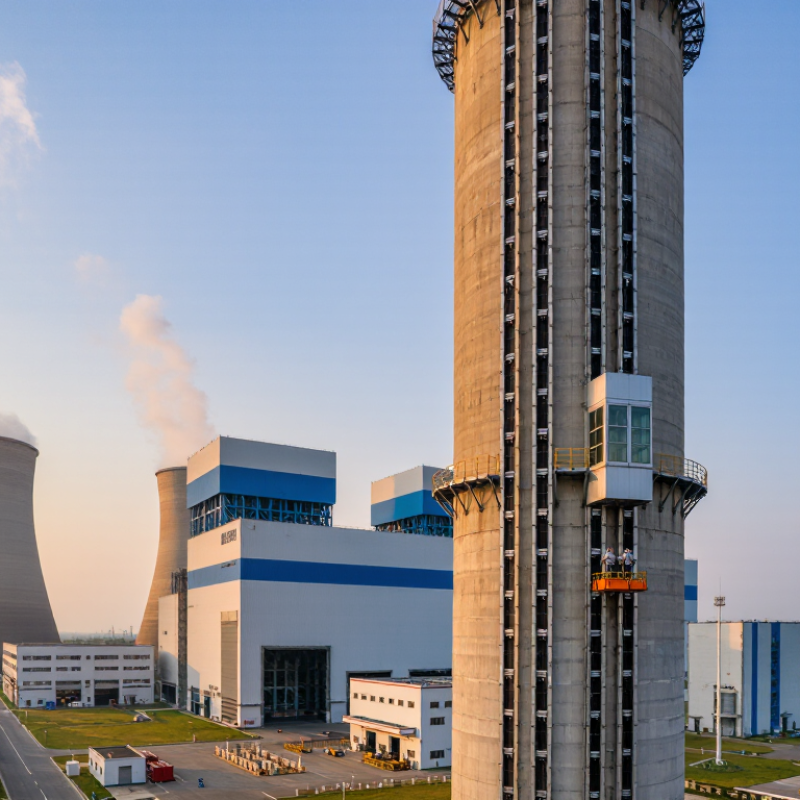
Why Are Thermal Power Chimneys Equipped With Elevators?
Chimney Structure and the Role of Elevators in Thermal Power Plants
A thermal power chimney is more than a tall concrete tube. It usually contains a structural shell, an internal flue, insulation, access platforms, and monitoring points. The shell resists wind and seismic forces. The liner handles hot, corrosive exhaust gases. In tall units, these layers can create a narrow, vertical service route hundreds of metres above ground.
The IEA’s Electricity 2024 report states that coal generated about 35% of global electricity in 2023, while gas produced roughly 22%. This scale explains why chimney maintenance remains an important engineering task. Elevators reduce travel time during inspections, liner repairs, lighting checks, and emergency response. A technician carrying gas detectors, harnesses, and tools cannot safely depend on ladders alone. The lift also limits physical exhaustion before critical work begins.
The elevator normally runs inside a protected shaft and stops at several platforms. Door interlocks, overspeed protection, emergency communication, and backup lowering systems are essential. The U.S. EPA’s AP-42 guidance identifies stack temperature, exit velocity, diameter, and height as important dispersion parameters. Therefore, an elevator must not obstruct airflow or compromise the flue system. It serves people, not exhaust gases.
Not every chimney needs one. Shorter structures may use stairs or fixed ladders. That assumption can fail when inspection frequency increases. Global Energy Monitor’s Boom and Bust Coal 2024 report recorded about 2,130 gigawatts of operating coal capacity worldwide, leaving many ageing chimneys in service. Their elevators need scheduled testing, corrosion checks, and honest replacement planning. A neglected lift can turn routine maintenance into a serious delay.
| Data Dimension | Typical Design Data or Description | Structural or Operational Role | Why an Elevator Is Relevant |
|---|---|---|---|
| Chimney Function | Discharges treated or controlled flue gas at an elevated point | Promotes atmospheric dispersion and helps reduce ground-level pollutant concentrations when designed and operated correctly. | Inspection personnel may need to reach high-level platforms, sampling points, dampers, liners, and lighting systems. |
| Common Chimney Height | Approximately 80–300 m for large thermal power applications | Height depends on plant capacity, flue-gas conditions, surrounding terrain, environmental assessment, and applicable regulations. | Stair travel over this distance is slow, physically demanding, and unsuitable for frequent maintenance or emergency access. |
| Chimney Configuration | Single-flue, multi-flue, or common chimney arrangement | A reinforced-concrete shell may contain one or more steel, brick, or acid-resistant flue liners. | An elevator can serve multiple access levels and reduce travel time around complex internal arrangements. |
| Outer Shell | Usually reinforced concrete or another engineered structural system | Resists wind, seismic loads, temperature effects, and the weight of platforms and attached equipment. | The elevator guide system is fixed to the shell or to a dedicated internal support structure designed for operational loads. |
| Flue Liner | Steel, acid-resistant masonry, or specialized corrosion-resistant lining | Protects the structural shell from hot, moisture-laden, and potentially corrosive flue gas. | Elevator access allows inspection of liner joints, expansion zones, supports, deposits, and corrosion damage. |
| Flue-Gas Temperature | Often about 80–160°C after heat recovery and pollution-control equipment; actual values vary | Temperature affects buoyancy, condensation risk, thermal expansion, and liner selection. | Maintenance teams can reach temperature-monitoring devices and inspect areas affected by condensation or thermal cycling. |
| Internal Access Levels | Intermediate platforms, rest platforms, sampling platforms, and top working platforms | Platforms divide the vertical space and provide safe locations for inspection, testing, and equipment maintenance. | The elevator provides practical access between levels; stairs and ladders remain important as alternate escape routes. |
| Typical Elevator Type | Industrial personnel elevator or maintenance hoist designed for vertical chimney service | The system is selected according to travel height, rated load, duty cycle, environmental exposure, and safety requirements. | It transports authorized personnel and, within its rated capacity, tools and inspection equipment. |
| Rated Load | Commonly several hundred kilograms; exact capacity is project-specific | Capacity must account for passengers, tools, protective equipment, and permitted maintenance materials. | A defined load rating prevents overloading and supports safe planning for inspection and repair activities. |
| Travel Speed | Typically much slower than a commercial building elevator and set by the equipment design | Industrial chimney elevators prioritize controlled movement, reliability, and safe operation in a narrow vertical shaft. | Even moderate speed substantially reduces access time compared with climbing several hundred metres of stairs. |
| Elevator Drive and Guides | Electric drive with guide rails or tensioned guide systems | The arrangement keeps the car stable and limits sway in a tall, slender structure exposed to wind-induced movement. | Stable travel is essential when carrying personnel and sensitive inspection instruments. |
| Safety Devices | Overspeed protection, emergency stop, door interlocks, limit switches, emergency lighting, and communication provisions | Safety equipment is selected and maintained according to applicable industrial elevator, lifting-equipment, and workplace-safety requirements. | These features help protect occupants during power loss, abnormal travel, overspeed, or access-door opening. |
| Emergency Access | Fixed stairs, ladders, landings, and designated evacuation routes remain necessary | An elevator should not be treated as the sole means of escape during fire, smoke release, power failure, or other emergencies. | The elevator improves routine access, while independent stairs or ladders provide redundancy for evacuation and rescue. |
| Inspection Activities | Visual checks, thickness measurements, liner inspections, weld examinations, temperature checks, and instrument servicing | Inspection programs identify cracking, corrosion, settlement, leakage, vibration effects, and deterioration of attached components. | Fast vertical access makes scheduled inspections more efficient and reduces worker fatigue. |
| Maintenance Frequency | Determined by the plant maintenance program, operating conditions, inspection findings, and statutory requirements | High-moisture or chemically aggressive flue gas can increase inspection and maintenance needs. | Frequent access to elevated equipment is safer and more productive with a dedicated industrial elevator. |
| Environmental Exposure | Wind, rain, temperature changes, vibration, condensation, and corrosive deposits | These factors influence shell design, liner durability, elevator enclosure, electrical protection, and corrosion control. | Elevator components require suitable protection, regular checks, and controlled access under harsh operating conditions. |
| Primary Benefit | Reduced vertical travel time and lower physical demand on workers | Improves the practicality of inspection and maintenance at high elevations without changing the chimney’s gas-dispersion function. | The elevator is installed mainly for safe and efficient human access, not to improve flue-gas flow. |



 Ms.Lily International Sales Director
 Join 3S Group