
Leave Your Message
Selecting reliable Thermal Power Chimneys Elevator manufacturers requires more than comparing prices or catalog photographs. These elevators operate inside tall, demanding structures where heat, dust, vibration, and corrosion can affect daily performance. A dependable manufacturer should understand chimney access systems, not simply adapt a standard industrial lift.
This guide examines manufacturers through practical and professional criteria. These include load capacity, travel speed, guide rail stability, emergency braking, door protection, and corrosion-resistant materials. Maintenance access matters too. Technicians may work hundreds of meters above ground, often near hot flue-gas equipment. Clear controls and reliable communication systems can reduce confusion during inspections.
Look for documented testing, traceable components, installation experience, and responsive after-sales support. A strong supplier should explain its design assumptions in plain language. It should also provide inspection schedules, replacement guidance, and realistic service limitations. Factory visits, project references, and technical drawings can reveal more than polished marketing claims.
Details matter. A poorly sealed control cabinet may collect dust. A weak drainage design may accelerate rust around the shaft. Small faults can become expensive disruptions.
No ranking is perfect.
Manufacturers also differ by region, chimney design, operating temperature, and site conditions. Therefore, the best choice depends on verified engineering suitability rather than reputation alone. Some published performance claims may require independent confirmation. That is worth remembering.
By focusing on evidence, field experience, and transparent communication, plant owners can build a more reliable shortlist. The following overview introduces leading manufacturers and explains how their capabilities may fit modern thermal power chimney maintenance needs.
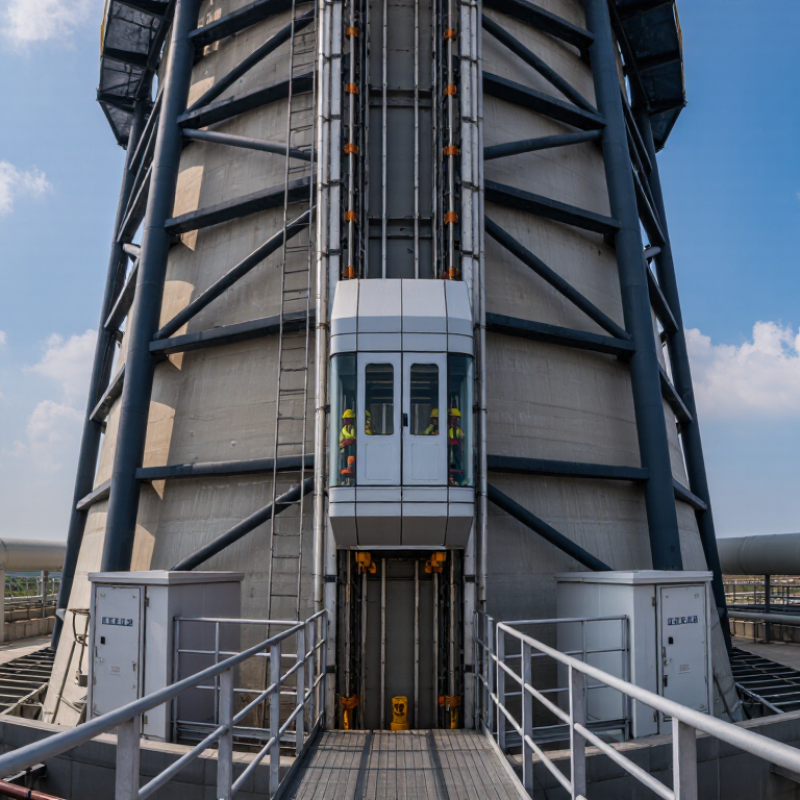
Thermal Power Chimney Elevators: Purpose, Design, and Applications
Thermal power chimney elevators provide controlled access inside tall exhaust structures. They support inspections, lighting repairs, sensor maintenance, and corrosion surveys. This access matters as coal-fired generation remains significant worldwide. The IEA’s Coal 2024 report states that global coal demand reached a record level in 2023. Global Energy Monitor also tracks about 2,100 GW of operating coal capacity worldwide. Many facilities therefore still require dependable vertical access.
A chimney elevator must tolerate heat, soot, moisture, vibration, and strong wind. Typical designs use guided cabins, corrosion-resistant rails, emergency brakes, door interlocks, and overload protection. Engineers also assess shaft alignment, power failure recovery, rescue access, and communication systems. The elevator should not replace a compliant emergency stairway. That assumption can create serious risk. Applications include concrete chimneys, steel stacks, flue-gas desulfurization towers, and inspection shafts. In practice, maintenance teams often value smooth stopping more than high travel speed. A small landing shock can damage instruments or unsettle workers.
Tips: Specify the highest operating temperature, travel height, rated load, and inspection frequency before selecting equipment. Check local elevator codes, electrical classifications, and chimney access requirements. Request documented brake tests and corrosion-control procedures. Do not rely only on catalog capacity. Real conditions are usually harsher. A design may look excellent on paper, yet poor drainage or weak communication can undermine daily safety.
| Data Dimension | Typical Configuration or Requirement | Purpose in Thermal Power Chimney Service | Design and Safety Considerations |
|---|---|---|---|
| Primary Function | Vertical personnel and maintenance access inside or alongside a chimney | Reduces climbing time and supports inspection, repair, cleaning, sampling, and instrumentation work | Usually designed as a dedicated industrial access system rather than a conventional commercial passenger lift |
| Typical Chimney Applications | Flue-gas stacks serving coal-fired, oil-fired, gas-fired, biomass, and waste-to-energy units | Provides access to stack platforms, liners, monitoring points, expansion-joint zones, and internal equipment | Materials and controls must be selected for corrosive flue gas, condensation, dust, heat, and vibration |
| Elevator Arrangement | Guided cage or platform moving on vertical guide rails, wire ropes, racks, or traction equipment | Matches the access geometry of cylindrical, concrete, steel, or multi-flue chimneys | Guide systems require accurate alignment, corrosion protection, and inspection access along the travel path |
| Drive System | Electric traction, geared hoist, rack-and-pinion, or wire-rope lifting system | Provides controlled vertical travel over the full height of the chimney | Drive selection depends on travel height, rated load, duty cycle, emergency lowering, and available power |
| Rated Load | Common project ranges are approximately 300–1,000 kg; the final value is project-specific | Accommodates maintenance personnel, tools, inspection instruments, and selected replacement parts | Rated load must include occupants, equipment, dynamic effects, and any permitted material-handling allowance |
| Passenger Capacity | Frequently configured for a small maintenance crew, typically 2–8 persons depending on cage size and load rating | Allows inspection teams to reach elevated work areas without repeated ladder climbing | Occupancy limits must be permanently marked and controlled by the safety system |
| Travel Height | Determined by the chimney height and the lowest-to-highest required landing; tall stacks may require several hundred metres of travel | Provides access to multiple platforms and service levels | Rope length, guide-rail joints, evacuation planning, communication, and rescue procedures become more critical as height increases |
| Travel Speed | Low to moderate industrial speeds are commonly selected to prioritize stability, controlled stopping, and safe boarding | Improves access efficiency while limiting discomfort and load movement | Actual speed is established through risk assessment, equipment type, travel height, and applicable local regulations |
| Landing Access | Fixed landings or platforms positioned at inspection decks, sampling levels, damper areas, and outlet structures | Creates safe transfer points between the elevator and chimney work areas | Landing gates, interlocks, guardrails, toe boards, lighting, and slip-resistant surfaces are required where applicable |
| Operating Environment | High humidity, acidic condensation, sulfur compounds, dust, elevated temperature, and outdoor weather exposure | Allows the system to operate in the difficult environment associated with flue-gas stacks | Use corrosion-resistant or protected components, sealed electrical enclosures, suitable lubricants, and temperature-rated equipment |
| Temperature Design | Selected according to the actual location: internal chimney zones may experience heat and flue-gas exposure, while external systems face ambient conditions | Maintains reliable operation during normal generation and planned maintenance | Operating temperature limits must be verified for motors, brakes, cables, sensors, batteries, seals, and control cabinets |
| Safety Braking | Service brake combined with an independent overspeed or emergency safety device | Stops or limits unintended downward movement of the cage or platform | Safety devices should be fail-safe, periodically tested, and accessible for inspection without exposing personnel to avoidable hazards |
| Emergency Protection | Emergency stop circuits, overspeed protection, upper and lower limit switches, door interlocks, and overload monitoring | Reduces the likelihood of travel beyond safe limits, open-door movement, overloading, or uncontrolled motion | Safety circuits should be independent where required and designed so that loss of power places the system in a safe condition |
| Power Supply | Industrial AC electrical supply with local isolator and protected control circuits; backup provisions may be added | Supports the drive, lighting, ventilation, alarms, communication, and control equipment | Electrical installation must account for grounding, lightning protection, electromagnetic interference, and hazardous environmental conditions |
| Emergency Evacuation | Emergency descent, manual rescue arrangement, or access to adjacent ladders and platforms | Provides a controlled response if the elevator stops between landings or loses power | Rescue procedures, trained personnel, communication equipment, and periodic drills are essential for tall chimney installations |
| Cabin or Platform Design | Enclosed cage, semi-enclosed cage, or standing platform with guardrails and access gate | Balances protection from the chimney environment with ventilation and visibility | Floor loading, headroom, ventilation, lighting, fall protection, and tool retention should be defined before fabrication |
| Materials | Painted or galvanized structural steel, stainless steel, coated fasteners, and protected electrical components | Improves service life in humid and chemically aggressive stack environments | Material selection should consider acid dew-point corrosion, galvanic compatibility, weld quality, and coating maintenance |
| Control Mode | Car controls with landing call stations, inspection mode, and local maintenance controls | Enables normal access, testing, troubleshooting, and controlled maintenance operation | Controls should prevent unauthorized use and provide clear status indication, alarms, and fault diagnostics |
| Communication | Two-way communication or emergency call system between the cage, control point, and plant operations room | Allows occupants to report faults or request assistance during an interruption | Communication equipment must remain usable in high-noise, high-humidity, and low-visibility conditions |
| Ventilation and Lighting | Mechanical or natural ventilation with dedicated internal lighting and emergency illumination | Maintains visibility and acceptable conditions during inspection and maintenance activities | Lighting and ventilation equipment should be protected against moisture, dust, vibration, and temperature exposure |
| Inspection Frequency | Pre-use checks, routine operator inspections, scheduled maintenance, and periodic safety-device testing | Identifies wear, corrosion, rope or rail damage, brake issues, and control faults before operation | Inspection intervals must follow the equipment manual, site procedures, statutory requirements, and risk assessment |
| Common Maintenance Tasks | Lubrication, brake testing, rope or rack inspection, guide alignment checks, fastener checks, cleaning, and electrical testing | Preserves lifting performance and reduces unplanned downtime | Maintenance should be performed under isolation and permit-to-work procedures with protection against falls and falling objects |
| Applicable Compliance Basis | Local lifting-equipment and workplace-safety laws, together with relevant elevator, machinery, electrical, and fall-protection standards | Provides the legal and technical framework for design, installation, commissioning, and operation | The governing requirements vary by country and by whether the equipment is classified as a lift, hoist, work platform, or industrial access system |
| Best-Fit Use Case | Frequent inspection and maintenance of tall stacks where ladders would create excessive travel time or worker fatigue | Improves access efficiency and can reduce exposure to prolonged ladder climbing | It does not remove the need for fall protection, confined-space controls, gas monitoring, or plant isolation where those hazards exist |



 Ms.Lily International Sales Director
 Join 3S Group