Choosing the right Warehousing And Logistics Elevator supplier can influence safety, throughput, and long-term operating costs. In busy distribution centers, elevators move pallets, cartons, and personnel between levels. A delayed lift can interrupt picking schedules within minutes. A reliable system keeps goods moving steadily.
This guide introduces the Top 10 Warehousing And Logistics Elevator Suppliers through practical evaluation criteria. These include lifting capacity, platform size, travel speed, safety controls, maintenance support, customization, energy use, and documented industry experience. A supplier may offer advanced equipment, yet weak after-sales service can create serious operational pressure. We therefore consider installation quality, spare-parts availability, response times, and training support. These details matter beside impressive product brochures.
The comparison also reflects real warehouse conditions. Dust can affect sensors. Uneven loading can test platform stability. Frequent stops can increase wear on doors, chains, and hydraulic components. Experienced suppliers should explain these risks clearly and recommend suitable protection. Certifications and inspection records deserve careful review, not casual acceptance. We cannot treat every published specification as equally dependable. Some supplier claims require independent verification, and local requirements may change the final decision. That limitation should remain visible.
Readers can use this overview as a starting point, not a substitute for site assessment. Measure floor openings, ceiling heights, load patterns, and traffic frequency before requesting quotations. A modest elevator with dependable service may outperform a more sophisticated model. That is easy to overlook. The strongest suppliers combine engineering knowledge, transparent communication, and consistent support after installation.
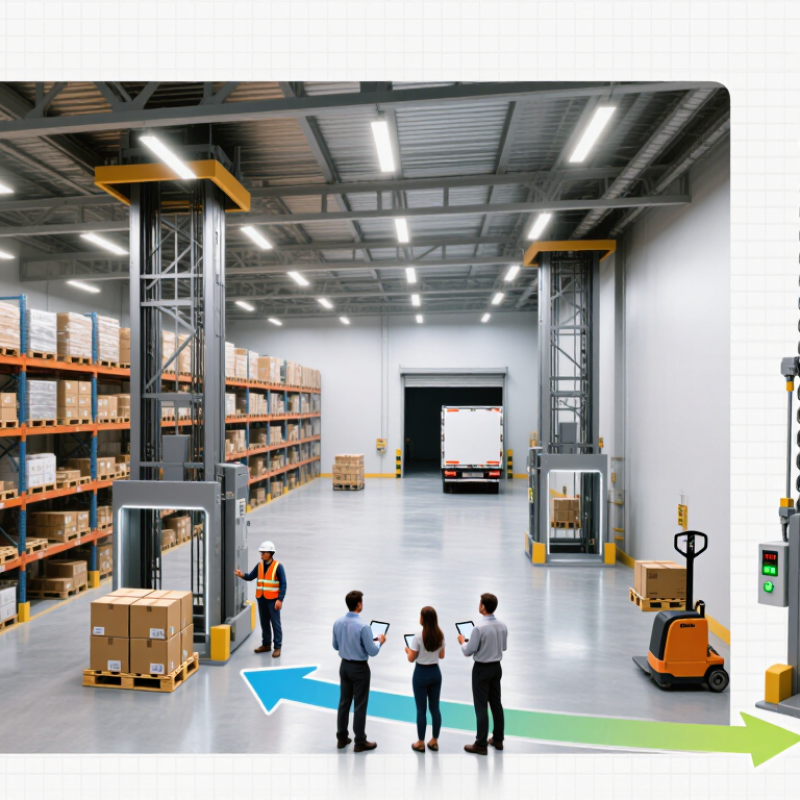
Warehousing and logistics elevators are vertical transport systems designed to move goods between storage levels, loading areas, and production floors. They handle pallets, cartons, cages, and sometimes wheeled equipment. They are not passenger elevators. They are working equipment.
A typical system includes a reinforced cabin, guide rails, lifting machinery, landing doors, controls, and safety interlocks. Capacity, platform size, travel height, and loading method should match the warehouse process. A pallet elevator may need a low entry threshold, while a small goods lift may suit cartons and containers. In daily operation, smooth starts matter. Sudden movement can shift stacked goods and damage packaging.
A reliable selection begins with an on-site assessment. Measure the heaviest load, busiest periods, floor openings, aisle width, and available power. Check how operators will load the cabin with pallet trucks or carts. Clearance is often underestimated. So is door-opening time. Safety devices, overload protection, emergency controls, and regular inspections should support the equipment’s working environment and applicable requirements. Dust, temperature changes, moisture, and frequent cycling can affect performance.
A common mistake is choosing only by maximum lifting capacity. That figure does not explain real productivity. A slower lift may create queues during peak receiving hours. I would also question layouts that force workers to make unnecessary crossings. The best design is not always the largest one. It is the one that moves goods safely, consistently, and with fewer handling steps.
Modern warehouse elevator systems are becoming essential in multi-level distribution centers. The 2024 MHI Annual Industry Report found that 83% of supply-chain professionals expect to increase technology investment within five years. Vertical movement now deserves the same planning attention as conveyors and storage racks.
Key features include automatic leveling, guarded doors, load sensors, and programmable speed control. These functions help move pallets between floors while reducing handling delays. Integration with warehouse management software can assign lift jobs, track loads, and prevent unnecessary travel. Real-time condition monitoring also detects unusual vibration, motor heat, or repeated door faults. Small warning signs matter.
Energy efficiency is another important measure. Regenerative drives can return braking energy to the electrical system during descent. LED lighting and standby modes can reduce idle consumption. However, a faster elevator is not automatically a better elevator. Throughput depends on door opening time, traffic patterns, pallet quality, and operator training. The Global Warehousing Automation Market report by Interact Analysis projects continued strong growth in warehouse automation through 2027, but investment decisions still require site-specific testing.
In practical use, a reliable system should recover gracefully after power interruptions and provide clear manual access for maintenance. Engineers should review peak-hour queues, emergency stopping distances, and floor loading limits before installation. Even experienced teams can underestimate seasonal congestion. Performance figures often look perfect on paper. Real warehouses are less cooperative.
Evaluating a warehouse elevator supplier starts with the operating profile, not a glossy catalog. Record load, travel height, daily cycles, pallet dimensions, temperature, dust, and available pit space. A supplier should convert these details into a written specification. Ask how the design handles uneven loading and frequent door openings. Small omissions become expensive downtime. The right question is simple: can the equipment match your busiest shift, not its average day?
Review engineering evidence, not promises. Request load calculations, safety test records, maintenance intervals, spare-parts availability, and documented compliance with applicable local standards. Inspect the control panel, emergency lowering method, door interlocks, and guarding during a site visit. Ask for references from facilities with similar throughput. A quiet showroom proves little. Compare response times, technician coverage, training, warranty limits, and total cost over ten years. The cheapest quote may become the costliest choice after one failed shift.
Leave room for doubt. A supplier may answer quickly yet avoid a difficult question about overloads or corrosion. That is a warning. Score each candidate using the same matrix, then let operations, maintenance, and safety staff challenge the result. I would also require a commissioning plan with acceptance tests under realistic pallet loads. This step is often rushed. It should not be.
| Rank | Evaluation Dimension | Recommended Data to Verify | Logistics-Operations Benchmark | Why It Matters | Suggested Weight |
|---|---|---|---|---|---|
| 1 | Safety Certification and Compliance | Applicable design codes, third-party certificates, risk assessments, and inspection records | Compliance with the applicable local code, such as EN 81-20/EN 81-50 or ASME A17.1/CSA B44, where relevant | Reduces personnel, cargo, and regulatory risks in high-traffic warehouse environments | 20% |
| 2 | Rated Load Capacity | Maximum payload, cage dimensions, door opening, and pallet or roll-cage compatibility | Common goods-lift capacities range from approximately 1,000 kg to more than 5,000 kg; confirm the required engineering load | Prevents overloading and ensures compatibility with forklifts, pallets, and automated handling equipment | 15% |
| 3 | Throughput and Duty Cycle | Rated speed, travel distance, starts per hour, peak-hour demand, and average cycle time | Evaluate against the site’s measured demand; heavy-duty freight systems are commonly specified for frequent daily cycles rather than occasional use | Insufficient cycle capacity can create bottlenecks at receiving, storage, picking, and dispatch points | 15% |
| 4 | Reliability and Availability | Proven uptime, failure-rate records, preventive-maintenance plan, and availability calculation method | Require a documented availability target, with exclusions and measurement periods clearly defined in the contract | Elevator downtime can interrupt vertical movement of inventory and reduce overall warehouse productivity | 12% |
| 5 | Service Network and Response Time | Local technicians, spare-parts inventory, remote diagnostics, emergency support, and escalation process | Set written response and restoration targets appropriate to operating hours and business-criticality | Fast support limits shipment delays and reduces the operational impact of equipment faults | 10% |
| 6 | Site-Fit and Installation Requirements | Shaft dimensions, pit depth, overhead clearance, power supply, floor loading, weather exposure, and installation sequence | Require a site survey and verified dimensional drawings before final quotation or construction approval | Early verification prevents costly structural modifications and commissioning delays | 8% |
| 7 | Warehouse-System Integration | PLC interfaces, warehouse-management-system signals, barcode or RFID options, interlocks, and API documentation | Confirm supported industrial protocols, safety interlocks, access control, and data ownership requirements | Integration enables controlled routing, traceability, and fewer manual handling steps | 7% |
| 8 | Lead Time and Project Delivery | Engineering duration, manufacturing schedule, shipping terms, installation period, commissioning plan, and acceptance criteria | Compare a fully documented project schedule with milestone dates and clearly assigned responsibilities | Predictable delivery supports warehouse opening, expansion, and automation timelines | 5% |
| 9 | Energy Efficiency and Sustainability | Motor efficiency, regenerative-drive capability, standby controls, lighting load, and environmental documentation | Request measured or calculated energy data under defined load and traffic conditions rather than relying on general claims | Lower energy consumption can reduce operating costs in facilities with frequent vertical transport | 4% |
| 10 | Total Cost of Ownership | Purchase price, installation, maintenance, consumables, spare parts, energy, modernization, and disposal costs | Compare a multi-year lifecycle-cost model using the same utilization, service, and inflation assumptions | The lowest purchase price may result in higher downtime, maintenance, and replacement costs over the equipment life | 4% |
| Total Evaluation Weight | 100% | ||||
Top 10 Warehousing and Logistics Elevator Suppliers should be assessed beyond lifting capacity. A reliable supplier must understand pallet dimensions, traffic peaks, floor height, and maintenance access. MHI’s 2024 Annual Industry Report indicates that 82% of supply chain leaders expect artificial intelligence adoption within five years. This trend increases demand for elevators with sensors, remote monitoring, and fault diagnostics. However, smart controls cannot replace sound mechanical design.
The top 10 suppliers should provide documented load ratings, emergency systems, guarding solutions, and service response targets. The World Bank’s 2023 Logistics Performance Index shows that timeliness remains a major logistics performance factor. A delayed freight elevator can therefore disrupt picking schedules, loading bays, and customer deliveries. Look for suppliers that publish test procedures and spare-parts availability. Field experience matters, especially where dust, cold storage, or uneven pallets create daily stress. A weakness in many comparisons is overvaluing purchase price. Lifecycle cost deserves more attention, including energy use, inspections, downtime, and technician training. No scorecard is perfect. Real warehouse trials may reveal problems that brochures hide.
Comparing ten elevator suppliers requires more than checking lifting capacity and purchase price. Reliable suppliers provide site surveys, traffic analysis, installation support, operator training, and scheduled maintenance. These services reduce delays when a warehouse handles mixed pallets, cartons, and temperature-sensitive goods. Response time matters too. A useful supplier should offer remote diagnostics and clearly defined spare-parts availability. Vague service promises deserve careful questioning.
Technology separates capable systems from basic lifting equipment. Look for variable-speed drives, automatic positioning, barcode integration, and sensors that detect uneven loads. Energy-efficient motors can reduce operating costs during continuous shifts. Safety features should include door interlocks, overload protection, emergency lowering, and access monitoring. However, more technology is not always better. Poorly trained staff may bypass alerts or misunderstand maintenance data. That weakness is often overlooked.
Market application should guide the final choice. Compact vertical lifts suit urban fulfillment centers with limited floor space. Heavy-duty goods lifts support manufacturing plants and distribution hubs. High-speed units can improve parcel throughput, but they may increase noise and maintenance demands. Food facilities need washable surfaces and careful material selection. Cold-storage sites require components that perform reliably below freezing. Construction projects need flexible scheduling and strong installation coordination. In practice, supplier comparisons remain imperfect because published performance rarely reflects every building layout. Trial testing and reference checks can expose those gaps.